OMYA, Inc
61 Main Street
Proctor, Vermont 05765
802 459 3311 fax 802 459 2125
September 29, 2000
Dear Citizens of Danby:
Thank you for inviting OMYA to the September 26th Danby Select Board Meeting to present information about the Jobe Phillips Quarry.
As I explained at that meeting, OMYA has commissioned studies to find facts and give expert analysis on issues like transportation and the economic impacts of the quarry on Danby. We appreciate your being patient waiting for the studies and we share the frustration of not having all the data at our fingertips by the meeting on the 26th. However, when the studies are in, we will return to Danby and answer any questions you might have.
I think it might help everyone if I describe the process we have to go through to prepare an Act 250 permit application. There is a graphic depiction enclosed with this letter, and the description is as follows:
1. OMYA's Geology Department studies rock formations continually around the world to identify new sources of calcium carbonate for our plants to respond to market growth
2. Once a new source is identified, our staff does a feasibility study to generate a preliminary outline of the project. That was the document sent to Danby, Tinmouth, and Wallingford at the beginning of the year. This was not a final plan, but a proposal meant to be a starting point for the discussion process with the towns.
3. In addition to attending Select Board meetings, we sent our team to interview individuals in various towns who could be directly impacted by the project. Although many concerns are similar at different locations, our goal was to hear all concerns AND identify potential solutions. Once the concerns and questions are identified, we will then define a scope of work, hire experts, outline the options, and get recommendations based on the expert analysis. Information from that process will be provided to the towns involved before we submit our Act 250-permit application.
4. Equipped with that information, we will work with each town to develop a plan to mitigate any impacts that are projected to occur.
5. The studies and any agreements between OMYA and the towns will be submitted as a part of our Act 250 application to open the Jobe Phillips Quarry.
We hope that by sharing information with each of the towns involved, we can save money for the taxpayers. If a town decides to hire its own, regardless of our studies, it can do so, of course. In any event, when the towns have the raw data available that we have paid for, it should result in a less expensive undertaking.
Thinking over the questions from the meeting, I believe there are issues that warrant further clarification. One is jobs that will be created by the Jobe Phillips Quarry project. While those jobs are still in the possible category, we have job openings at our Vermont operations that may be suitable for some Danby residents. I have asked John Suddarth to provide job postings on a regular basis to the town of Danby to be posted in the Town Office and on town bulletin boards. In addition, they are posted on our web site at www.omya-NA.com. We welcome applications from Danby residents.
Another issue was what financial responsibility OMYA would take for increases in costs for road maintenance if trucks are selected as the mode of transport for the ore. OMYA will help cover costs associated with upgrading and maintenance consistent with the costs borne by other users of the roads, recognizing that the towns and state, and possibly others, presently pay for maintenance of the roads. Until the studies are back and we know if we will use trucks, what the route selected is, what is to be improved, and how much it will cost, it is difficult to say exactly what OMYA will do.
We have a good record for paying our fair share at other quarries. For example, we supported the upgrade and maintenance of Foote Street in Middlebury when we used that route, then built a new private road in Middlebury from our quarry to Route 7. We bought land and donated it to the State for turning and passing lanes on Route 7 to the Florence plant; and we paid for the upgrade of a town road used to gain access to a quarry in the northern part of the state at Shelburne.
Then there is the issue of health effects, especially the presence, if any, of tremolite in our calcium carbonate. I noted at the meeting that calcium carbonate is a food additive. We all consume it daily to maintain strong teeth and bones. In the workplace, it is regulated as a "nuisance" dust but it is not a hazardous material. Tremolite occurs naturally; in back yards, playgrounds and fields. Nevertheless, the rock from Jobe Phillips and all other OMYA sites in Vermont has been, and will continue to be, examined in extraordinary detail for all fibrous minerals, using the method recommended by Federal Regulatory Agencies
There is no tremolite asbestos, or any other types of asbestos, in our Vermont deposits of calcium carbonate. There is no risk of fibers being released into the air, because there are no fibers in the rock.
I am personally committed to staying in touch with your Select Board and will answer your questions throughout the process and beyond. As soon as the studies are in, we will have another forum in Danby, if invited by the Select Board, and will answer your questions. If, in the meantime, you have questions or concerns, please call me at 770-7123 or call Don Burns at 770-7190.
Sincerely, OMYA, Inc.
Jim Reddy
Executive Vice President
Attachments:
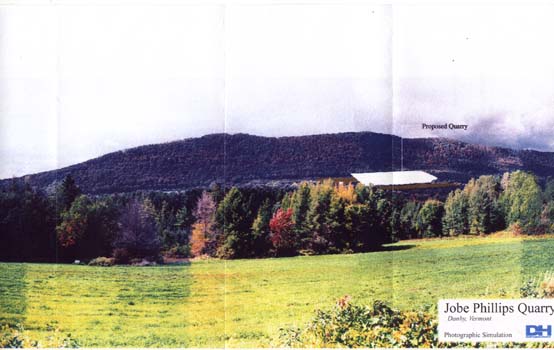
Picture
Flow chart of process
| PROCESS FOR PREPARATION OF ACT 250 APPLICATION
|
||
|
PHASE I Scientists identify exceptional deposits of calcium carbonate. Once identified, an internal feasibility study is undertaken & an initial proposal is created. |
PHASE II Initial proposal is circulated to towns involved in the project (extraction, transportation, processing); interviews with town officials and residents begin. Using feedback generated, define scope of work for studies and hire experts. |
PHASE III Create plans to address concerns and mitigate potential impacts. These plans, along with the studies by experts, are submitted with the Act 250 Permit Application. |